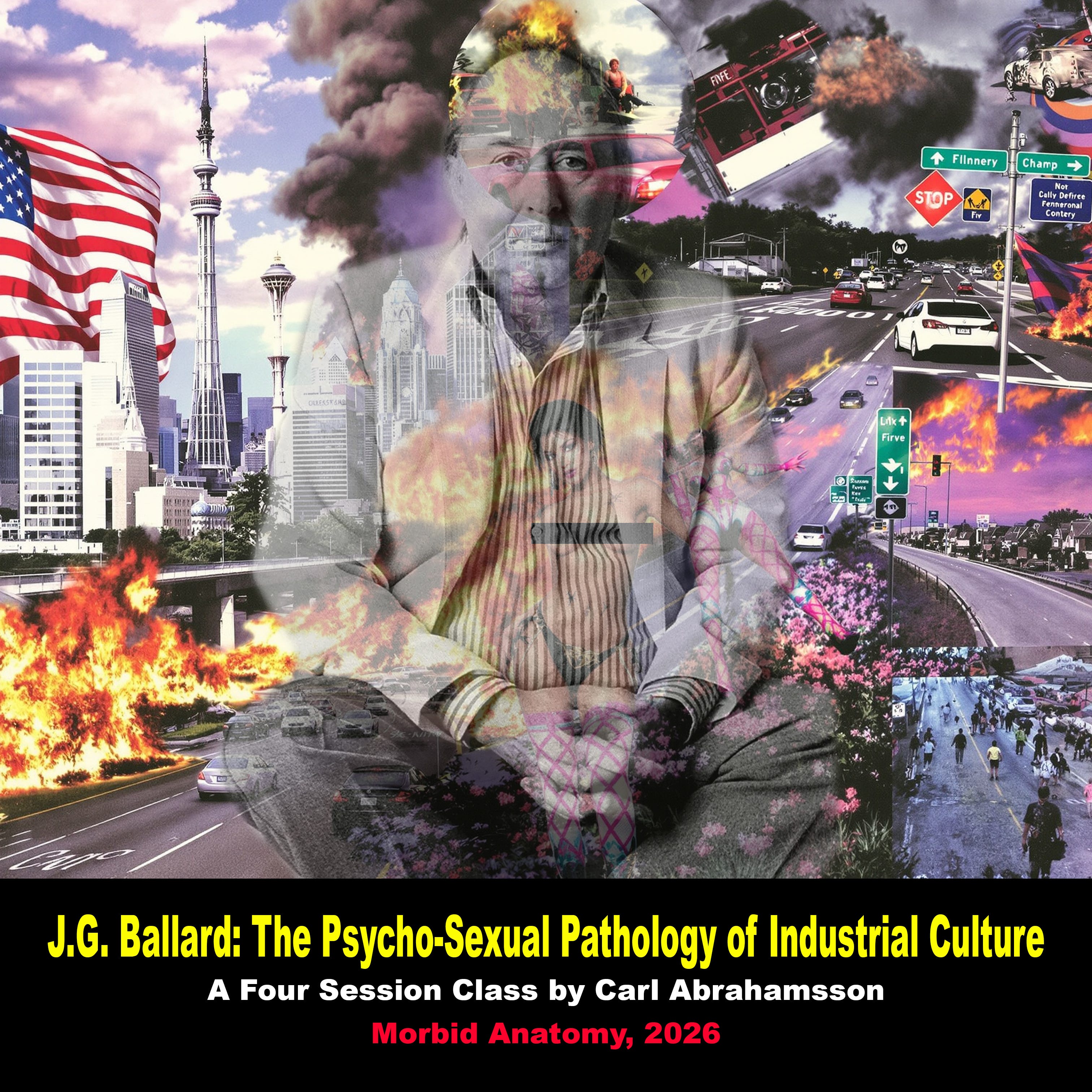
In the ripples of the recently published and highly recommended J.G. Ballard biography The Illuminated Man: Life, Death and the Worlds of J. G. Ballard, I have put together an introduction class about this truly amazing and prophetic author. For four consecutive Sundays, beginning July 5th, we will go through his life, literary work, and why it still has relevance today. Sign up for ”The Psychosexual Pathology of Industrial Culture: The World of J.G. Ballard” HERE.
Some writers describe the world. J.G. Ballard (1930-2009) rearranged its furniture in our dreams and then asked why we found the new arrangement so seductive. Across four richly interconnected sessions, this class traces how a boy who grew up watching empire collapse from behind the fence of a wartime internment camp became one of the most unnervingly prescient imaginations of the last century—and why his “Ballardian” vision now feels less like science fiction than like a description of any Tuesday afternoon.
We begin in Shanghai, 1930. Ballard’s childhood in a foreign concession—cocktails and tennis courts coexisting with poverty and distant gunfire—taught him a lesson he would never unlearn: you can watch an entire social order collapse from a balcony. Interned by the Japanese at Lunghua, the young Ballard discovered that catastrophe is not only trauma but a peculiar kind of liberation, a laboratory in which the scenery falls away and you learn what people truly are.
Repatriated to a grey, rationed Britain, he found postwar suburbia almost metaphysically drab—and channelled all of it into science fiction. But not the rockets-and-rayguns kind. Through the magazine New Worlds and its “New Wave,” Ballard famously turned the genre’s gaze from outer space to “inner space”: the psyche under pressure from media, cars, high-rises, and the afterlife of empire. His real alien planet was the human mind.
Here the course slows down to savor Ballard’s great catastrophe novels. In The Drowned World, a flooded London becomes not a disaster to be solved but a mirror reflecting humanity’s pull toward deep time and dissolution. The Drought hardens this into a parched parable of fraying social bonds; The Crystal World freezes it into glittering, beautiful stasis. In each, Ballard refuses the heroic rescue plot. His characters don’t fight the flood—they walk into it. The disturbing question beneath all three: what if the disasters we fear are also the fantasies we secretly rehearse?
Then comes The Atrocity Exhibition, his most radical work—a fragmented anti-novel that reads like a deranged clinical report on media-saturated culture. Assassinations, car crashes, celebrity faces, and weapons tests collide and recombine. Decades before the smartphone, Ballard mapped the psyche trained to greet atrocity with a mixture of arousal and numbness. It now reads, uncomfortably, like a user manual for the scrolling feed.
The course’s middle stretch follows Ballard out of dreamlike landscapes and onto the actual motorways of West London. Crash fuses sex, technology, and death on the Westway, treating the road system as a new unconscious—and unmasking the eroticism already lurking in car culture. High-Rise seals a cross-section of the professional middle class inside a luxury tower and watches, almost gleefully, as petty grievances curdle into tribal warfare. No villain commands the collapse; the residents simply discover they enjoy it.
We trace these obsessions through Concrete Island, and their adoption by the industrial-music underground, where “Ballardian” became shorthand for a whole aesthetic. As Thatcher’s Britain reshaped the country into business parks and shopping malls, Ballard didn’t need to change course. The world simply caught up with him.
The final session opens with Empire of the Sun, his semi-autobiographical war novel—the “Rosetta stone” revealing that every drowned city and fractured tower descends from that boy watching planes above a camp fence. From there we enter his late “corporate dystopias”: the sun-drenched resort of Cocaine Nights, the business park of Super-Cannes, where executives are prescribed nocturnal violence as psychological hygiene, and the mall-fascism of Kingdom Come. In these worlds, power wears no uniform. It operates through gated communities, security protocols, and charismatic insiders—crime repackaged as social glue, transgression in the service of productivity.
The course closes by asking why Ballard still matters. The answer isn’t that he predicted everything. It’s that he taught us a way of seeing: to read tower blocks, motorways, and malls as diagrams of who moves freely and at what psychological cost; to refuse comforting villains and recognize how ordinary desires—for speed, privacy, spectacle—aggregate into inhuman systems; to notice what our own screens are doing to us.
Ballard is offered here not as an oracle but as a companion—and a provocateur who refuses to flatter us. His great impoliteness was to insist that the lure of disaster lives inside ordinary people, that we are not just victims of modern structures but their dreamers and willing engineers.
To finish this course is to step out into a car park or departure lounge and realize, with a slight chill, that you were never quite outside his pages to begin with.