

Mind Over Magick
A Great Piece of Occulturation

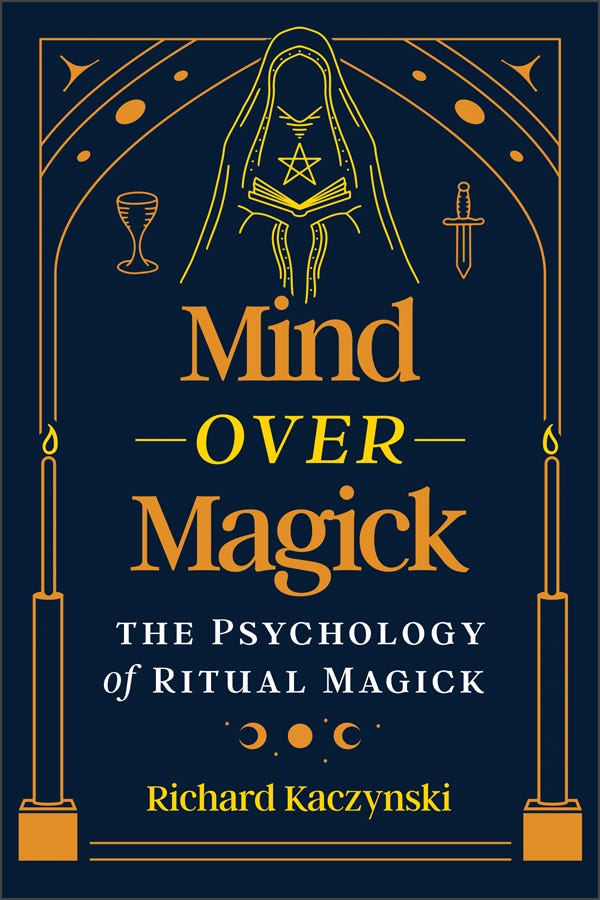
Richard Kaczynski’s Mind Over Magick is the rare occult book that can sit comfortably on a lodge altar and a university bookshelf at the same time. It’s not a debunking tract dressed up in robes, and it’s not a credulous hymn to “mystery” either. It is exactly what its subtitle promises: a psychological and neuroscientific examination of ritual magick, written by someone who has done the statistical work in academia and the astral work in the temple.
Kaczynski starts with autobiography—ghosts in the family home, footsteps on the stairs, pool balls rolling in the night, a childhood brush with “Bigfoot” footprints in his mother’s garden. These aren’t offered as proof of anything. They are his entry point into the basic fact that a huge portion of the population has had at least one experience they would describe as paranormal, mystical, or uncanny. He backs this with data: large percentages of Americans believe in ghosts, spirits, witchcraft; a majority report at least one anomalous experience. Scholars like Whitley Strieber and Jeffrey Kripal supply archives of letters and case reports that are too numerous and too consistent to shrug off as marginal.
Instead of taking the familiar “either it literally happened or they’re all deluded” fork, Kaczynski chooses a third path: whatever else may or may not be going on, these experiences are real psychological events. They have structure. They have discernible triggers. They are worth understanding, especially for people who intentionally court them through ritual.
The early chapters lay out the perceptual and cognitive machinery that underwrites magical practice. Gestalt psychology, pareidolia, and apophenia show how the brain is wired to see patterns and agency in a noisy environment. Recorded examples from Satanic backmasking panics and EVP demonstrate how expectation shapes perception: tell people what to listen for in the static, and they will usually hear it. Yet this isn’t used to sneer at magicians. Instead, he makes the case that ritual is a deliberate way of feeding that pattern‑hungry system—giving it symbols, correspondences, synchronicities to work with, and then mining the resulting meanings.
Jung’s concept of synchronicity and contemporary research into “meaningful coincidence” get a sympathetic treatment. Kaczynski knows the skeptical literature well enough to cite it, but he also recognizes that for many people, including working therapists, the experience of meaningful coincidence can be stabilizing and clarifying rather than pathological. Magicians, with their instruction to “interpret every phenomenon as a particular dealing of God with my soul,” are simply taking that tendency and making a method of it.
From there, the book becomes a tour through the main elements of a magical life, with each piece set alongside what psychology and neuroscience can say about it.
Daily practice—journaling, banishings, adorations, meditation—is reframed through research on habit formation and well‑being. A magical record is not just a fetish object; it’s a hedge against the unreliability of autobiographical memory, which we now know is constantly reconstructed and prone to distortion, especially around intense events. Small, regular practices can produce a “slow-drip” effect on mood and resilience that resembles what studies find for exercise or religious observance.
On ritual implements and robes, Kaczynski draws on consumer psychology and “enclothed cognition.” When people assemble or make objects themselves, they tend to value them more—the IKEA effect—and invest them with identity. Sacred tools crafted by the magician, consecrated and used only in ritual, become literal extensions of the self in a way William James would recognize. Likewise, clothing has measurable effects on self‑perception and performance. Lab coats improve certain kinds of attention, business suits shift people into more abstract thinking and dominance behavior, nurse’s scrubs increase empathy. It is not a stretch to extend this to temple robes and grade signs: when you put on the regalia of the magician and move in specific ways, you are engaging the same brain systems that support role adoption and behavioral change.
Meditation, yoga, breathwork, and chanting get a full airing in the middle sections. Kaczynski reviews dozens of studies showing short‑ and long‑term changes in brain structure and function among regular meditators: increased gray matter in attention and interoception networks, thicker corpus callosums, greater connectivity between regions. He keeps the discussion accessible, but doesn’t shy away from details like which types of meditation (concentrative, mindfulness, loving‑kindness, mantra) light up which regions. For the ritualist, the implication is clear: asana, pranayama, dharana, mantra—these are not incidental Eastern decorations; they are ways of deliberately reshaping the mind that does the magic.
He’s equally comfortable on more controversial ground. His section on parapsychology and psi research is brief but fair. He summarizes long‑running Ganzfeld telepathy experiments, Bem’s precognition studies, and meta‑analyses that find small but statistically significant effects. Rather than declaring victory for the paranormal, he uses them to raise a deeper dilemma: if such effects are real, then “mind over matter” can contaminate experimental outcomes everywhere, not just in parapsychology; if they aren’t real, then there is something badly wrong with how we’re doing and interpreting science. Either way, simple dismissals don’t hold.
Group ritual and initiation are handled with welcome nuance. Drawing on social psychology, Kaczynski examines how ordeal, secrecy, and shared experience influence attraction to groups. Classic experiments on severity of initiation, newer work on hazing, and field studies of fraternities and sororities suggest that moderate, meaningful ordeals can strengthen affiliation, while humiliating or irrelevant hazing damages it. That maps neatly onto initiatory practice in magical orders and covens. He adds research on synchrony—walking in step, drumming together, chanting—which reliably increases feelings of unity and cooperation and shows up in synchronized changes in heart rate and skin conductance. Many of the standard features of group ritual, in other words, have well‑documented effects on bonding and behavior.
Perhaps the most striking material in the book concerns “sensed presence” experiences—what mountaineers and explorers call the Third Man. Shackleton’s extra companion on the glacier, trapped miners sensing a figure beside them, Charles Lindbergh’s “ghostly presences” in the cockpit, a lost child led by an invisible friend: Kaczynski lines these up next to Crowley’s Aiwass, Jung’s Philemon, and Yeats’s communicators. Neuroscience can induce similar “presences” with magnetic stimulation of the temporal lobes, and neurological patients sometimes report localized unseen companions. Rather than using this to rule out spirits, he suggests that magicians have learned, over centuries, to engage the same circuits intentionally—through sensory deprivation, scrying, repetitive prayer, and ceremonial structure.
All of this could have collapsed into “it’s all in your head” reductionism. What saves the book from that is Kaczynski’s constant return to practice and to usefulness. Knowing that certain postures influence mood doesn’t mean a godform assumption is “just posture.” It means you can design your rite more skillfully. Understanding that surprise enhances learning doesn’t make an initiation trivial—it explains why spoilers blunt its impact.
The final chapters are a kind of manifesto for “scientific illuminism.” Here Kaczynski draws on his background in statistics and research design to outline how a magician might actually test their own results: defining clear, falsifiable hypotheses (“a Jupiter talisman will increase unexpected income over the next month”), measuring relevant variables, considering control periods, and being honest about alternative explanations like bonuses, seasonal patterns, or wishful editing of one’s journal. He lays out threats to internal validity in plain language and encourages replication of one’s own workings. It’s not prescriptive dogma so much as an invitation: treat your practice as a long‑term experiment, and you will learn more, and faster, about what truly works for you.
What makes Mind Over Magick worth reading is not any one argument or study, but the overall stance. Kaczynski refuses to choose between science and sorcery. The nervous system is not the enemy of the sacred; it is the medium through which the sacred is experienced. For practitioners who are tired of being told they’re crazy, and for empirically minded readers who suspect that ritual and mysticism are telling us something important about the mind, this book offers a bridge: solidly researched, clearly written, and genuinely respectful of both sides of the equation.
Get your own copy of Mind Over Magick here.

