

The Fenris Wolf 4 intro

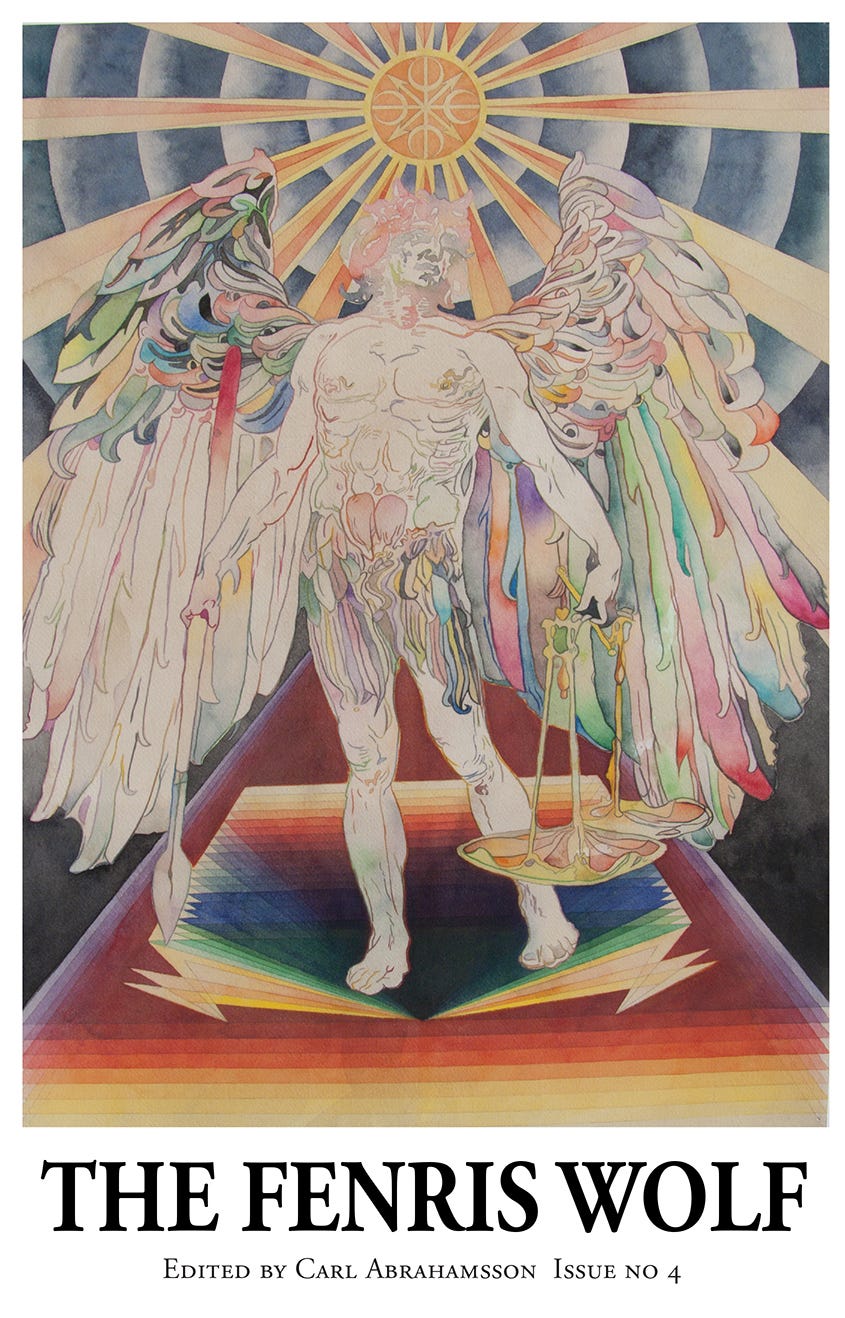
As a little treat in awaiting the publication of The Fenris Wolf 13 (patience, patience!), I share the introduction to The Fenris Wolf 4, originally published in 2011 (how time flies!)
The whys of yesterday are the why-nots of today
(A foreword)
Our perception of chronological time is remarkable and must truly be one of the cornerstones of the term “subjectivity”. We can rationally note that an objective consensus-time has passed but may still feel that no time has passed at all. This latter sentiment is what I’m feeling right this moment, and I ascribe all virtues and truths to that feeling.
So, basically no time has passed since the latest issue of The Fenris Wolf was published in 1993. But still, I feel it’s high time a new one is published. I do hope you agree.
Although the previous issues were joint efforts in many ways, they also very much reflected my own interests and inclinations. I don’t think that has changed. In fact, very little has changed. When I started the project, it was in part a continuation of my work with various subcultural fanzines in Sweden, and in part an indulgence in my own budding metaphysical interests. The concept of “Occulture”, as codified by Thee Temple Ov Psychick Youth and its protagonist Genesis Breyer P-Orridge, was indeed a very fitting headline. The first three issues of The Fenris Wolf are basically three facets of the same rough (philosopher’s?) stone – the occultural one.
In my preparation of the fourth issue (and yes, I have to admit it: it did take a long time in the chronological sense!), there were many bursts of inspiration and effort. Approximately one every three years or so. I wanted to maintain an eclectic and openminded editorial attitude (I still do) and collected material from all corners of the globe. But my own interests in regard to the hocus pocus stuff had changed somewhat. After the initial rush of youthful enthusiasm and enchanting meetings with many remarkable men and women, I noticed that my own mind was working overtime seeing patterns and similarities on more general levels. We live in a decidedly magical world and most of the people on this planet perceive it that way. And yet our own supposedly civilized culture seems unwilling to acknowledge that fact. This was well worth some attention.
As I had absolutely no intention of going back to university, I simply developed my already existing “Institute of Comparative Misanthropology” to a similar one preoccupied with “Magico-anthropology”. That was that and it still is. The Fenris Wolf was slightly pushed to the back of my mind though, as the Institute embarked on its first major expedition/project. In 2000, the book Bardo Tibet was issued by the Swedish publishing company Fischer & co. It’s basically a photo book by the talented Max Fredrikson, but with a lengthy introduction by myself and ICM colleagues Henrik Bogdan (nowadays an academic superstar in his own right) and Danish adventurer extraordinaire Peder Byberg. We traveled for two months in Northern India in 1996 and then for another two months in Nepal and Tibet in 1999. The work focussed on magical aspects of Vajrayana Buddhism, and we interviewed a great many people – monks, nuns, lamas, lay people, etc. The fruits of this labour, in the substantial textual sense, have yet to be tasted. But they will be.
Anyway, the interesting and stimulating detours of life kept The Fenris Wolf slightly at bay, and I wasn’t really happy about that. Then, in 2009, I was invited to speak at the Equinox-gathering of minds in London. It was a fine opportunity to meet up with old friends and make some new ones. I realised that there was indeed still interest in The Fenris Wolf as an open-minded and eclectic source of challenging thoughts. And so, here we are.
You may have heard of the “Internet”? At times, I was tempted to jump overboard, abandon the printed matter-ship and give myself wholly to the demons of contemporary digiculture. But instead, I also tricked these demons: by dutifully sticking to my devotion to book-making, while at the same time serving them with new and perhaps more non-esoteric matter “online”.
I have more or less lost track of everyone I ought to thank during this winding chronological process, so I won’t even attempt it. Current kudos are in order though: first and foremost to all the contributors to this issue, for keeping a well-needed Promethean spirit alive, to Fredrik Söderberg especially for the cover art and for the donation of the series of 23 original drawings to the project, to Genesis Breyer P-Orridge for sparks and fuel, Margareta Abrahamsson, Sofia Lindström-Abrahamsson, to Mikael Prey for transcription help, Kenneth Anger, Brian Butler, Camilla Hyldal and the Danish Film School, Lars Top-Galia, Henrik Møll, Simon Kane, Raymond Salvatore Harmon, The Equinox-festival, Sylvie Walder, to Annabel and Michael Moynihan for invaluable help in so many ways, to Klett-Cotta for allowing me to publish Ernst Jünger’s classic LSD-account (for the first time ever in English!), also to Insel Verlag, and to Blanche Barton, Peter Gilmore and Peggy Nadramia for being there and fanning the flame so well. Thank you all very much!
Thanks and respect are also due the following extraordinary gentlemen, who moved onwards during this period of time: Timothy Leary, William Burroughs, Anton LaVey, Robert Anton Wilson, Paul Bowles, Ernst Jünger, Albert Hofmann, Conrad Rooks, Jhon Balance, Peter Christopherson, Kenneth Grant and Owsley Stanley. “You can check out anytime you want, but you can never leave.”
This issue is dedicated to genuinely creative, bold and daring individuals. I wonder: are you still out there?
Vade Ultra!
Carl Abrahamsson, Editor
Stockholm-Monstropolis, Vernal Equinox, 2011