

The Fenris Wolf 6 intro

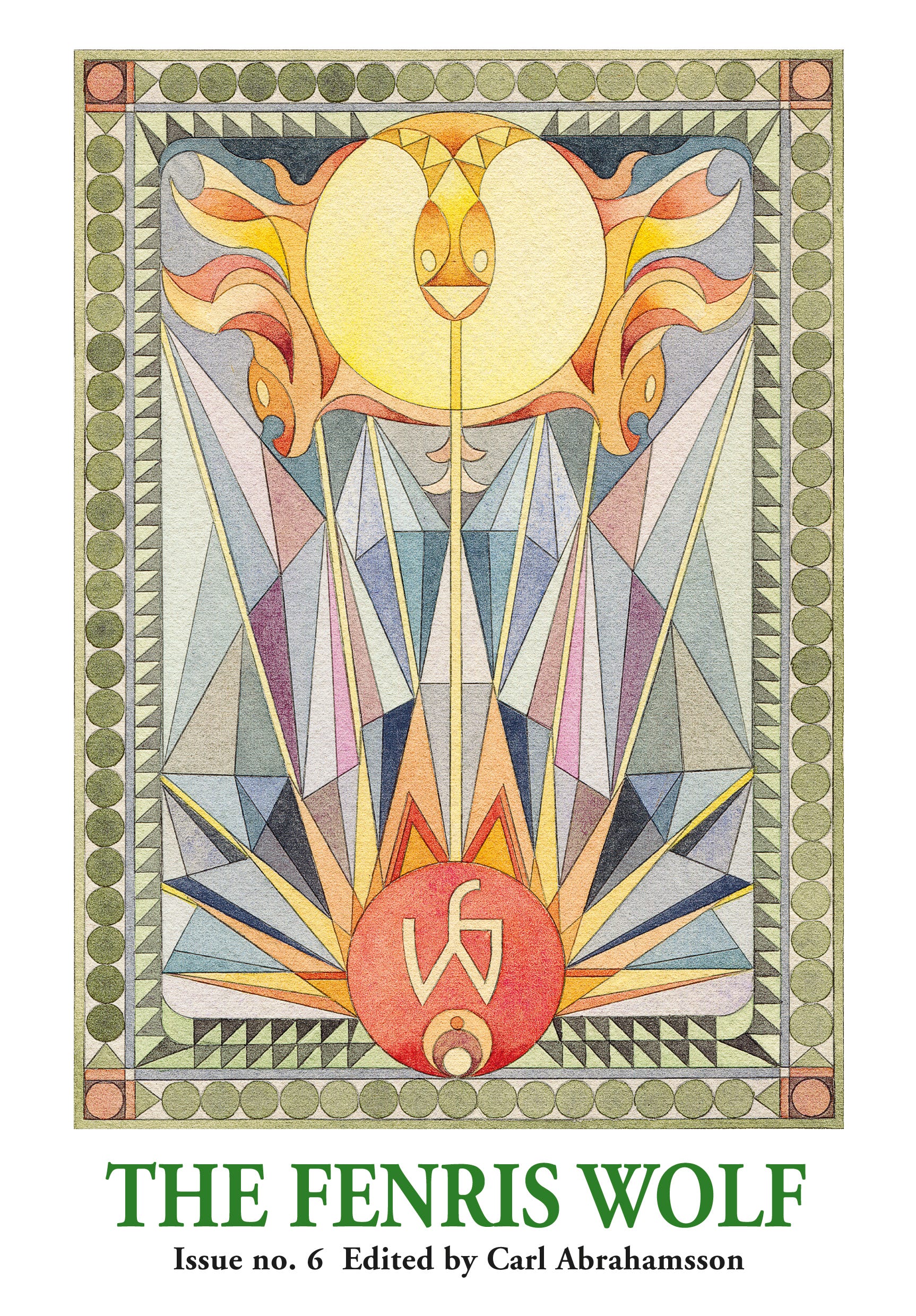
As a little treat in awaiting the publication of The Fenris Wolf 13, I share the introduction to The Fenris Wolf 6, originally published in 2013:
The job of the artist is always to deepen the mystery.
– Francis Bacon, 1599
I mean, there are all sorts of things happening all the time, and it’s difficult to distinguish between the conscious and the unconscious working, or the instinctive working, whichever you like to call it.
– Francis Bacon, 1975
On the same day as I started writing this introduction, I visited the Museum of Modern Art in Stockholm. That is always a pleasant experience, but this time even more so than usual. The huge Hilma af Klint exhibition at the time was remarkable and – dare I say it? – magical. Her almost unfathomably rich paintings displayed together like they were is a rare thing. But still, definitely a contemporary phenomenon, I’m happy to say. Towards the end of the exhibition period, a symposium on af Klint and the spiritual was held at the museum, bringing together bright minds from both the art world and academia. Would this have been possible ten years ago?
In an adjoining room at the museum, Karl Holmqvist’s large scale pentagram, hexagram and even one unicursal hexagram (!) emphasized the temple space potential of public museums. As did the entire bottom floor, packed with the museum’s vast collection of Surrealist gems, ranging from the many Duchamp items, to Dali, Bellmer, Ernst et al. I don’t think I’ve experienced this potent a magical wealth in a public setting since the Traces de Sacré exhibition at the Centre Georges Pompidou in Paris in 2008. There must surely be something in the air! Inhale!
And this was just one month prior to the international ESSWE-conference (The European Society for the Study of Western Esotericism) being held c/o the University of Gothenburg, containing a plethora of new international discussions and perspectives on health, religion, spirituality and the occult.
Not forgetting the Venice Biennale of 2013, which displayed Jung’s Liber Novus (the “Red Book”), Lady Frieda Harris’ original artwork for Crowley’s Thoth Tarot cards, Hans Bellmer, Hilma af Klint, our cover artist Fredrik Söderberg and many others.
The world has certainly come a long way since I started my own little Institute for Comparative Magico-anthropology some 23 years ago!
There are so many examples of current unions between art and the occult that it’s astounding. In the deep layers of the psyche, human desires, wills, emotions, needs and talents all blend together to create expressions that no longer have to be either-or but can very magically become both-and. Not only thematically of course, but also in the energy or “charge” – art with an intent, or an “estheticized” magical working or talisman.
The sphere of inspiration is of course essential, on the personal level as well as on that of studying phenomena like this more or less publicly. Inspiration is king in a culture of lethargic fragmentation. Equally essential is the concept of individual freedom of speech, something that should never be taken for granted too much. We currently have it. Let’s appreciate it and use it wisely to manifest whatever it is that we want. Not long ago, radical artists and ditto magicians were utterly stigmatised or worse. Not so anymore.
To quote Father Yod from the Source Family: “Life is a game. Play it.” In this abundant international environment in which art meets the occult, I would like to see The Fenris Wolf become a quaquaversal encyclopaedia of sorts, in which we can gently remove the dust from the old masters and at the same time celebrate new fertile minds. That’s how the game should be played.
Anton LaVey’s fascination with the creative potential of forgotten movies and with artificial companions is often popping up in new places and in new ways – a prime example of how originally “magical” concepts interact with culture and then mutate into the mainstream. In this issue of The Fenris Wolf, some of LaVey’s creative tenets are included to complement Anders Lundgren’s focus on contemporary Satanic cinema. This in turn brings to mind an old favourite of LaVey’s, the Swedish film Vaxdockan (Arne Mattsson, 1962, in English The Doll), an eerie little gem about a janitor whose feverish imagination makes a department store mannequin come alive. This film was an inspiration for LaVey in his development of artificial companions. As was German artist Hans Bellmer, whose psycho-sexual fascination with dolls is also chronicled in this issue by art critic Robert C Morgan.
The enchanted outer nature has also been a source of inspiration for artists and magicians alike. In this issue, we focus on the powerful animism of Sulamith Wülfing and Ernst Jünger, whose works of painting and writing respectively have inspired several generations to become more aware of nature and what it actually “contains”. The concept of “magical realism” is a fairly frequently used term in contemporary literary discourse, but it is perhaps nowhere as vibrant and alive as in Jünger’s novels.
Backtracking even further in time, we include pieces on two other important writers, Polish Tadeusz Micinski and French Joséphin Péladan. Both have been highly influential under the radar but are now surfacing to claim their rightful positions as literary instigators and occult freethinkers. We are especially proud to include recent translations into English of Péladan’s own writings by scholar Sasha Chaitow.
There is seldom an overall theme for The Fenris Wolf, but if one were to really try and see something along those lines, it would probably be the creative restlessness in trying to find one’s own position in the potential multitude of intersecting life-lines. Art and the occult have been two major arenas for this kind of soul-searching and soul-finding. Whether we’re journeying inwards or outwards, to the east or to the west, we’re always centrally placed. We are in the center, for good and bad. To widen the perspective, we need to distance ourselves from ourselves by some form of projection (for instance, through expressed will in ritual, by making an artwork, or by traveling). If we don’t, there’s always a danger that we lose track of what’s actually possible in life – a lot. To quote the Oracle at Delphi: “Know yourself!” And if there is something that unites art and the occult, it is the distinct potential of ecstasy, in the ekstasis sense. Leave yourself behind, if only for a minute, and you’ll come back the wiser.
A fine example of someone who did just that is Lawrence “Dadaji” Miles (1911-1991), who on Crowley’s suggestion traveled to India, became a guru, and then spent his life in various parts of Asia. His open-minded combination of a western-style magical thinking and an Indian spiritual tradition is an inspiring 20th century legacy, and I’m very proud to include his writings in this issue.
The current Zeitgeist apparently welcomes the irrational and its multifaceted expressions. Undoubtedly a backlash of too much rationality. It’s the eternal pendulum swinging back and forth and back again. The challenge now though, is to really sow some constructive seeds through the options readily available (magic as art, art as magic), so that when the pendulum swings back, the rationality won’t be as carelessly causal and brutally binary as it used to be. If some degree of increased open-mindedness can tag along on that swing, a lot has been achieved.
Thanks and praise to the following: All the contributors, without whom... Also, to those responsible for the Pleasure Dome symposium in Brighton in July 2012, especially Peter Grey and Alkistis Dimech. And to Martin Palmer of Forum Nidrosiae who was responsible for manifesting the important Here To Go conference (also focusing on the intersection between art and the esoteric) in Trondheim in October 2012.
Thanks also to Alexander Nym, William Breeze, Henrik Bogdan, Anthony Stansfeld Jones, Galleri Riis, Didrik Søderlind, Aleksandra Mazurek Søderlind, Cappelens Forslag in Oslo, Dan Jacobsson, the International Nath Order, Bali and Geraldine Beskin of the Atlantis Bookshop in London, JD Holmes, OTO Sweden, Peter Gilmore, Vera Nikolich, Andreas Kalliaridis and to all our supportive Edda-friends and booksellers. And finally to Fredrik Söderberg for friendship and great artworks!
An editorial note: As the texts in this issue stem from various minds from various cultures, there are obviously some stylistic inconsistencies. I have chosen to keep these, including possible “magical” language quirks and experiments, in the name of heterogeneous and creative integrity. However, for any spelling or typographical errors, pure and simple, I assume full responsibility.
Finally, I would like to say that the views and values expressed in the various texts in this eclectic anthology are those of the respective authors, and do not necessarily represent my own views, those of Trapart Books or any kind of general “Fenris Wolfian” perspective.
Vade Ultra!
Carl Abrahamsson
Stockholm-Monstropolis, May 23rd, 2013